Ultimate Outdoor Air Conditioning Buying Guide
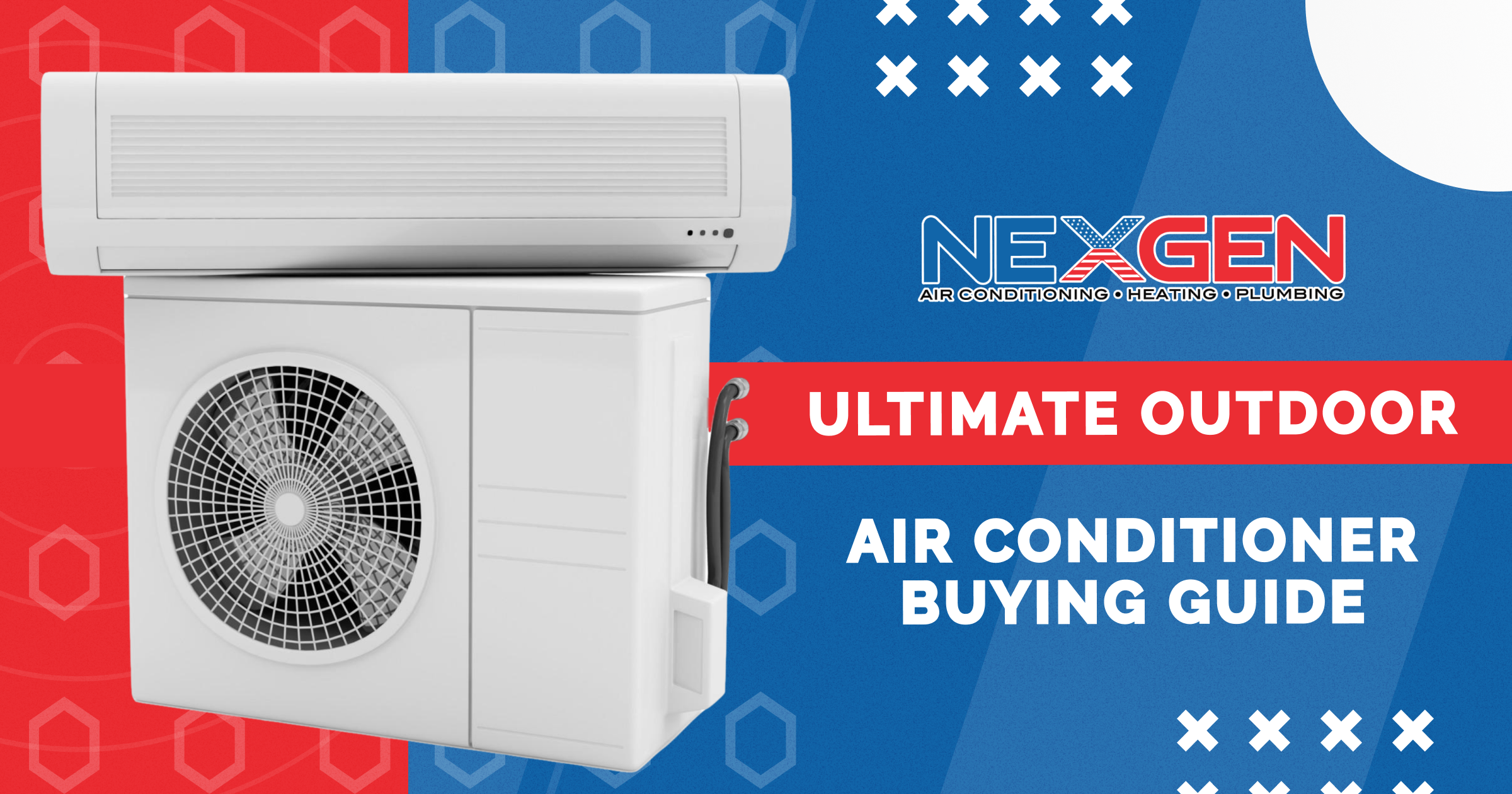
The outdoor air conditioner unit is an important part of your HVAC system. Containing the condenser coil, compressor, and fan, an outdoor unit releases heat absorbed from indoor air. But how do you choose an outdoor unit? It generally should match the brand and type of indoor air handler unit you have. In this buying guide, we’ll cover a few important considerations in selecting an outdoor air conditioner.
Types of Outdoor Air Conditioner Units
For a central air conditioning system, you’ll probably have one of two types of units. These are:
- Split-System Units: The outdoor cabinet includes the fan, compressor, and heat exchanger components, while the indoor cabinet has a heat exchanger and blower. It may also contain the furnace. A heat pump’s heat exchanger may be built into the indoor cabinet as well.
- Packaged Units: All major components are contained within a single unit, often placed on the roof (but sometimes near the foundation). A packaged unit can integrate a natural gas furnace or electric heating coils. It connects directly with supply and return ducts to deliver conditioned air and cycle it back through the system.
Choosing an Air Conditioner: Considerations
It’s unwise and impractical to choose just any air conditioner. For it to meet your needs and function properly, you need to think about:
- Size: Outdoor air conditioners are sized according to British Thermal Units (BTUs). The greater the square footage of your home, the more BTUs you’ll need. A one-ton AC outputs 12,000 BTUs per hour, so for a 2,000-square-foot home requiring a 3.5-ton system, you’d need a 42,000 BTU air conditioner. But the capacity you need is also affected by direct sunlight, the number of occupants, and heat-producing appliances.
- Efficiency: A high-efficiency air conditioner may cost you more upfront, but can save you money over time by using less electricity. The Seasonal Energy Efficiency Rating (SEER), listed on the unit’s Energy Guide® label, tells you how efficient it is. An air conditioner must be rated at least 13 SEER. Highly efficient units are rated from 15 to 17 SEER.
- Modern air conditioners also have energy-saving features like larger coils, allowing for more efficient heat transfer. Variable-speed blowers adjust to demand to reduce electricity consumption, while a fan-only switch lets you run the fan to achieve cooling without running the AC. An automatic delay fan switch lets the fan run long enough to allow residual cooling. Since a clear filter boosts efficiency, a filter indicator light to alert you that maintenance is needed helps.
- Location: Installing an outdoor air conditioner in the correct location is important. The unit should be installed where there’s enough room for proper airflow and for technicians to perform maintenance and repairs. Outdoor condenser units can be noisy, so you should pick a place where they won’t disturb neighbors or the occupants of your home.
Cost of Outdoor Air Conditioners
A central air conditioning system can cost from $3,000 to $7,000 to install. It’s usually not only the outdoor unit you need to install or replace. You need to factor in the cost of indoor air handlers, furnaces, ducts, and more as well as labor. A larger, more complex system can cost $20,000 or more.
Warranty
Make sure you fully understand the terms of the manufacturer’s warranty and what is covered. Some warranties provide different coverage for the unit and certain parts. Others may only cover labor for certain types of work. Neglecting to maintain the AC or having a non-authorized individual service it can void the warranty, so it’s important to understand all the terms and conditions.
Have NexGen Install Your Next Outdoor Air Conditioner
At NexGen, we supply and install high-quality, high-efficiency air conditioners and HVAC equipment. We specialize in all leading brands. Our licensed, insured technicians will help determine the right unit for your home to provide the update you need. In addition, comprehensive warranties and maintenance plans are available. For more information, call 833-729-9735 today.
What Equipment Is Used for Hydro Jetting Services?
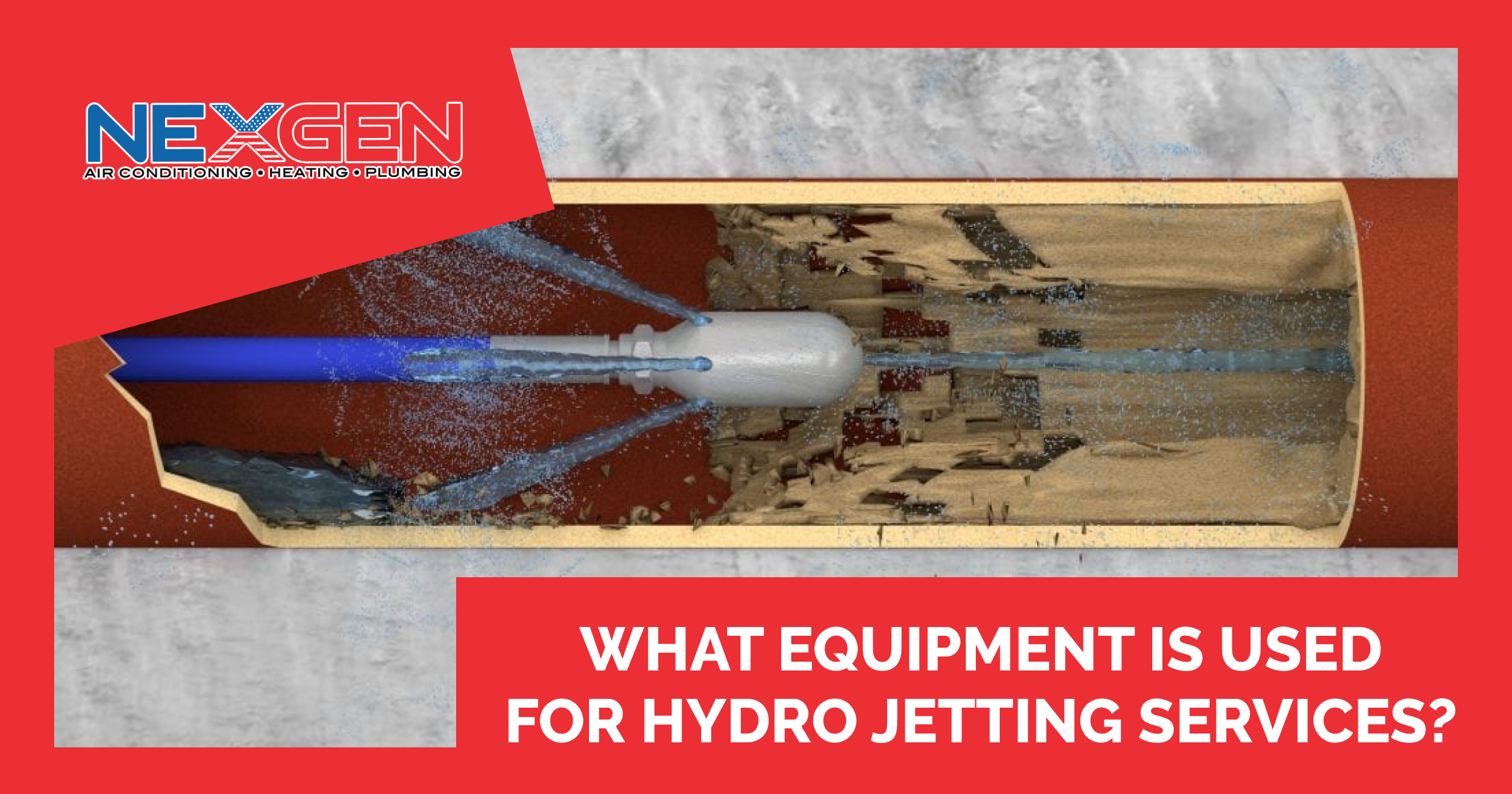
Hydro jetting is a technique that pushes high-pressure water into plumbing and sewer lines to clear blockages. As it also scours pipes clean, it can be used for preventative maintenance and clear grease, mineral scale, hair, food particles, and debris. Less debris stuck to the inside of pipes means it’s more difficult for additional material to accumulate. Hydro jetting services are typically more effective than plunging or snaking.
Here’s a look at the process and the equipment plumbers use during hydro jetting.
The Hydro Jetting Process
The jetter typically contains a water tank, hose, and nozzle. It also uses a device to pressurize water to 3,500 psi or more. There are different types of nozzles to accommodate different sizes and types of drains. Chisel-type nozzles can break through hardened clogs, ice, or tree roots. Hydro jetting is often preferred because it uses no chemicals, it’s relatively fast, and is unlikely to damage pipes. The results are long-lasting as well.
The equipment used during a hydro jetting service can include:
Hydro Jetting Engines
A hydro jetting machine can be powered by gas, diesel, or electricity and typically works with hot or cold water. Depending on the model, it may be stationary but is usually placed on a trailer pulled by a van or truck. A water jetter often has an engine/motor, pump, hose real, and water source so is often large and heavy. It is also capable of reaching deep into long drain pipes and sewer lines.
Pulse Jetter Systems
A pulsejet engine works much like a hydro-jet system. The difference is it uses pressure pulses generated by consecutive detonations inside the engine. Pulse jetters provide high compression and are therefore highly effective for sewer cleaning. Some water jetting machines and pressure washers can be converted to jetters by installing a pulsation valve; a handle lets the user achieve pulse or constant flow.
Video Inspection Cameras
Plumbers use high-resolution video cameras that attach to flexible lines, allowing them to see into sewage pipes. Technicians can find the source and location of a blockage and where to direct their hydro jetting equipment. They can also spot leaks or breaks where repairs are needed instead of high-pressure water than can worsen the problem.
Protective Equipment
Technicians performing hydro jetting services must follow safety guidelines that include wearing protective gear. You’ll likely see a hydro jetting technician wearing a safety helmet, face shield, goggles, work gloves, safety footwear, and protective overalls or jacket and trousers. Hydro jetting isn’t something just anyone can do. It requires training and familiarity with the equipment so the job can be completed safely.
Hydro Jetting Services Keep Your Plumbing in Top Shape
When debris remains stuck in pipes, it opens the door to future clogs. Blockages can build pressure in the system, which may eventually lead to burst pipes and broken sewer lines. Hydro jetting is a safe and effective process. It won’t damage pipes as long as they’re intact, even in older buildings. The process is also highly effective for high-demand plumbing, such as that in restaurants, as well as municipal pipes and commercial sewers.
Schedule a Hydro Jetting Service with NexGen
NexGen employs top-of-the-line equipment to clear drain and sewer lines. Our licensed and insured technicians are trained and experienced to complete any hydro jetting job. We’re available 24/7 to address plumbing emergencies in many Southern California locations. If your plumbing isn’t draining properly, there’s a clog, or it’s time to schedule maintenance, request hydro jetting service by calling 833-729-9735 today.
What Are the Benefits of Hydro Jetting Services?
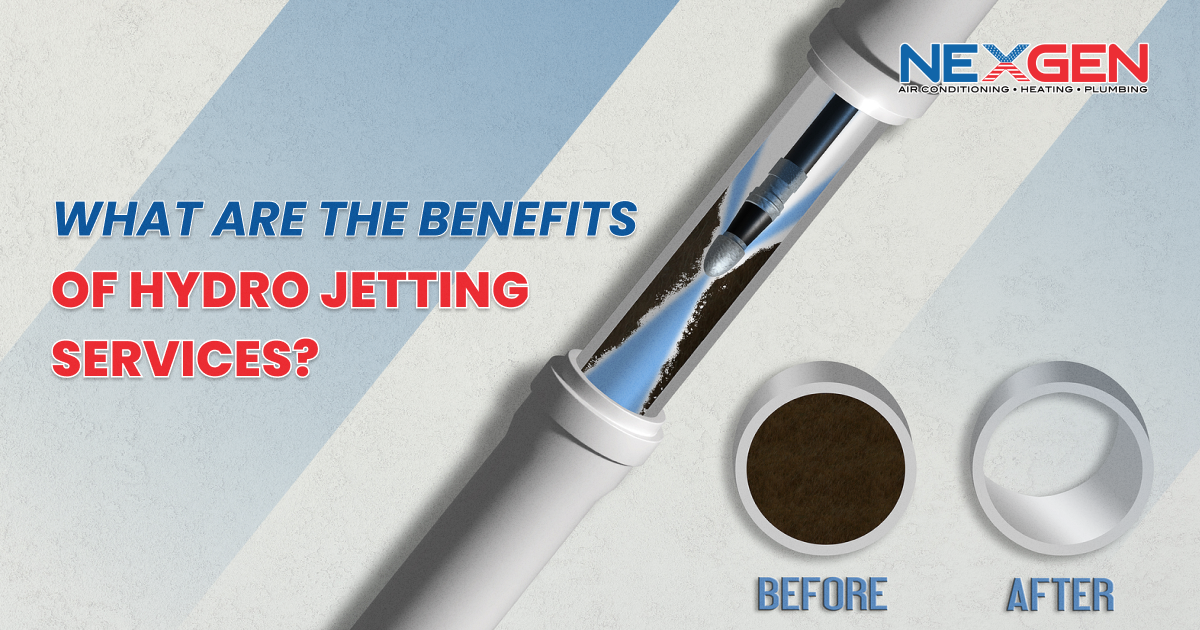
To most homeowners, plunging and snaking are more familiar methods of clearing clogged drains and blocked pipes. However, plumbers often use a process called hydro jetting. They inject water at high pressure into a plumbing or sewer line. A plumber will first use a video camera to see what’s causing the blockage. The hydro jetting machine can then be used so long as the pipe isn’t severely damaged. Here are some of the benefits of hydro jetting services:
An Extremely Thorough Cleaning
Almost any type of clog can be broken up by pressurized water. The material blocking the drain or pipe is dislodged and forced through the system. No residue is left behind that can cause another clog, and particles of any size are flushed away. Hydro jetting removes household grease, hair, paper products, sand, soil, mineral scale, tree roots, and foreign objects.
Works with Any Pipe or Plumbing System
Hydro jetting is extremely versatile and works with residential and commercial plumbing systems. It can be used with steel, cast iron, and clay pipes, as well as resin-based pipelines and cement sewer lines. Suited for jobs of any size, the process will remove blockages and also bacteria, eliminating odors and potential health hazards.
Accessibility and Convenience
Severe clogs are resolved without breaking apart walls or digging up your lawn or yard. Hydro jetting avoids expensive, time-consuming work such as digging trenches. It rarely damages pipes, so it’s safe even in older homes and can be performed in a house or via a sewer pipe cleanout. It is also more sanitary as it won’t expose the plumber or your family to sewage or debris.
Long-Lasting Results
Traditional methods of drain cleaning, including liquid drain cleaners, work only temporarily. While hydro jetting may cost more than other methods, it minimizes the odds of a drain or pipe clogging up again anytime soon. Pipe walls are scoured clean so there’s less material for debris and grime to stick to.
Cost-Savings
Professional pipe cleaning comes at a cost. Hydro jetting is more affordable and avoids repeated clogs, sewage backups, burst pipes, floods, and water damage that can end up costing you much more. Since a plumber uses a camera to spot exactly where the issue is, they can work efficiently and don’t need to open up pipes or break through walls. This saves a lot of work and drastically cuts down on the cost of service.
Safe for the Environment
Hydro jetting uses a lot of water but doesn’t introduce harmful chemicals into your plumbing system. It doesn’t risk polluting lakes, rivers, or groundwater with volatile toxins. Therefore, it protects local ecosystems as much as it does pipe and sewer lines.
Schedule Hydro Jetting Services with NexGen
Equipped with industrial-grade hydro jetting machines, NexGen’s licensed and insured technicians can clear any pipe of any type of blockage. Our process uses pressures of up to 4,000 psi to clean the insides of household pipes and sewer lines. To schedule a diagnostic camera inspection and hydro jetting service in your home or business, call 833-729-9735 today.
Why Is My AC Spitting Ice?
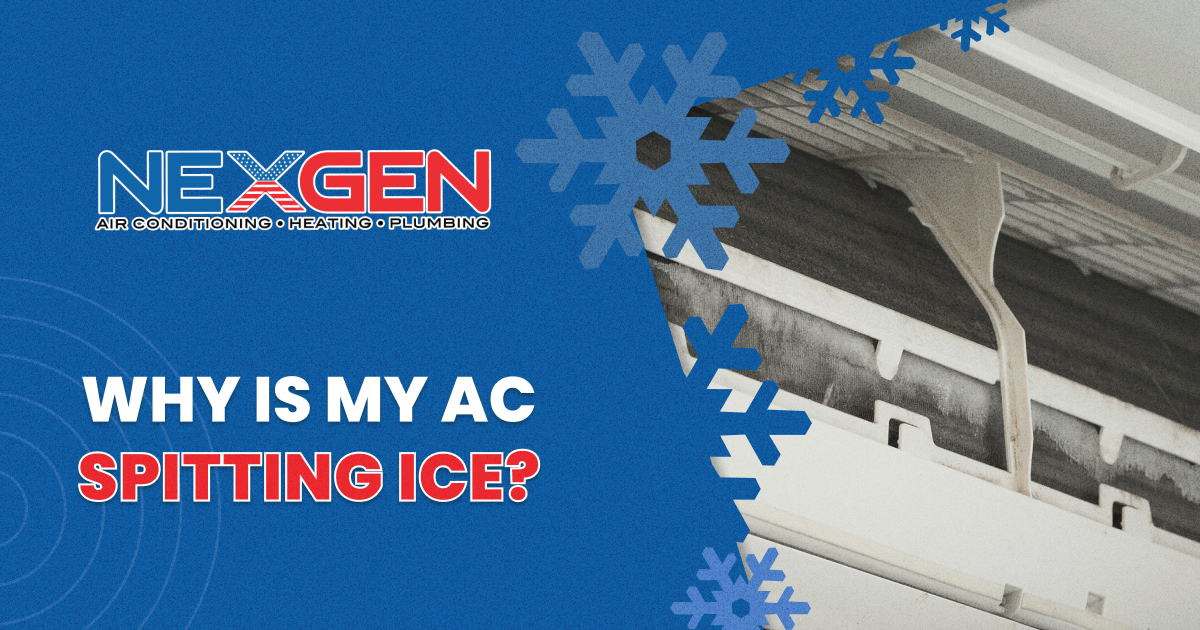
If your air conditioner is spitting out ice, the evaporator or condenser coils are probably frozen. Allowing your AC to continue running can cause serious damage, or at the very least accelerate wear. There are a few answers to the question, “Why is my AC spitting ice?” We will list a few below to help you troubleshoot the issue and know whether you need an HVAC technician’s help.
The Outside Temperature Has Dropped Below 62℉
An air conditioner is designed to keep your home cooler than the outside air temperature. It’s unlikely you’d want it to be colder than 62℉ indoors. If the AC is running full blast, this can cause the temperature around the evaporator coil to fall below freezing. Any condensation or moisture present will freeze on contact. When the outside temperature falls, run the AC in fan mode or turn the system off and use a ceiling fan or open a window.
Refrigerant Is Low and/or Leaking
If your AC is spitting ice and you hear a hissing sound, there’s likely a refrigerant leak. Only a trained technician can fix the problem. The coolant in your AC runs through a closed system. It should never be low. If it is, there will be serious temperature regulation problems in the system and components can easily freeze.
The AC Filter Is Dirty
A filter helps keep the air clean, but your air conditioner will run without it. However, when the filter gets dirty or clogged, it’s a different story. A clogged filter reduces airflow. Without enough air passing through them, the coils get colder causing ice to form. To avoid filter issues, replace it every three to six months.
The Evaporator Coil Is Dirty
When the evaporator coil is coated in dirt, it won’t allow for effective heat transfer. Warm air may never reach the coils. As a result, they get colder, and frost forms on the surface. Some of this ice can break loose in the airflow and get flung out of the AC vents.
Clogged Condensate Drain
The AC can spit water if the drain is clogged with dirt, mold, or algae. Moisture regularly condensates in an AC system; this is what the drip pan is for. It collects condensate so it can be evacuated via a drain. If the drain isn’t functioning, water can leak from the unit and performance can be affected. The coils may eventually freeze if the issue isn’t fixed.
The Fan Is Not Working Properly
Insufficient airflow can cause the coil to get cold and freeze, resulting in ice spitting from the AC. This may be due to a faulty fan motor, which can occur due to mechanical or electrical issues. The fan can become loose or break as well. Repairing or replacing an AC fan requires technical expertise.
How Do I Thaw Out My Air Conditioner?
You can thaw out the unit by running it in fan mode. The ice should start to break down soon after. You might also want to leave the system off, although the process may take five or more hours to complete. During that time, install a new filter just to be on the safe side.
Contact NexGen for Air Conditioning Repair
When customers ask us “Why is my AC spitting ice?”, there can be several answers. Depending on the problem, you may need the system inspected to determine whether any types of AC repair are needed. Google Certified for Home Services, we fix any air conditioning problem for clients in Southern California. For service by knowledgeable, experienced, and background-checked technicians, call 833-729-9735 today.
How Long Should an AC Run on a 100 Degree Day?
In Southern California, 100+ degree days are becoming more common. Extreme temperatures can put quite a strain on your AC. In general, air conditioners run in cycles of about 15 to 20 minutes. Longer than that can indicate a problem, but how long should an AC run on a 100-degree day?
Your AC will work harder to cool your home when outdoor temperatures are higher than normal. The compressor will run more frequently to reach and maintain the desired indoor temperature. It’s quite possible the air conditioner will run all the time if the temperature hits 100℉ and soars even higher.
Is My AC Working Properly?
Even though your AC will likely run often on a hot day, there are signs to look for that might indicate a problem, such as the AC running continuously, yet your home isn’t staying cool or getting cool at all. This can mean:
- The thermostat isn’t set right.
- Airflow is blocked.
- The evaporator or condenser coil is dirty.
- There’s a refrigerant leak.
- The AC is too small for your home.
The thermostat is the first place you should look. If it was accidentally switched to heating mode, then your home won’t get cool. Switching it to the proper mode should resolve the issue. Also, use the “auto” setting so the system will run until it reaches the desired temperature. For the most efficient performance, set the thermostat 20 degrees lower than the temperature outside. On a 100℉ day, set it to 78℉ to 80℉ to manage utility costs.
If there’s a lack of air flow, the filter may need to be changed or AC vents cleaned. But it may also mean your air conditioner needs professional repair. If an evaporator or condenser coil is dirty, this can block the transfer of heat, so air coming from the vents may be less cool. Low refrigerant levels can cause your AC to run all day. You may also hear a bubbling or hissing noise or see refrigerant leaking, which can be a dangerous situation.
If your AC isn’t working properly, it’s important to call an HVAC contractor quickly to resolve the problem.
Don’t Run Out and Get a Bigger AC
Average daily high temperatures seem to be increasing and there are more hot days per year than ever before. But an AC must still be properly sized. Oversizing a unit will cause your house to cool too quickly. It won’t run long enough to remove humidity, making it clammier and more conducive to condensation and mold. The system will also use more energy leading to higher electricity bills.
Tips for Running Your AC on a 100 Degree Day
In addition to keeping the thermostat at a reasonable setting, here are some ways you can keep your home cool on the hottest days:
- Close the doors to unused rooms.
- Cover windows that face direct sunlight.
- Let the dishwasher air dry with the door open.
- Air out clothes instead of using the clothes dryer.
- Take shorter showers and open a window to vent warm air.
- Use fans to improve air circulation and the cooling effect.
- Have a barbecue and cook outdoors.
- Make sure your AC is regularly maintained.
Contact NexGen for AC Repair, Installation, and Maintenance
NexGen is a leading air conditioning services company in Southern California. If you’re wondering how long an AC should run on a 100 degree day, and suspect your system isn’t running properly, our licensed, insured technicians will quickly identify and fix any underlying issue. Google Certified for home services, we service all types, makes, and models of ACs. We know air conditioners tend to break down on the hottest days. Call 833-729-9735 to request immediate residential and commercial AC services.
The Top 5 Most Expensive HVAC & Plumbing Repairs
When you add up the expenses of major home repairs, you can understand why proper care and maintenance are so important. Major components and the labor needed to replace them can cost hundreds to thousands of dollars. Here, we’ll look at some of the most expensive HVAC and plumbing repair jobs you might encounter:
-
1. Bathroom Water Damage
Leaking, standing, or running water will damage your home more quickly than you might think. It can soak through flooring materials, walls, and framing. Leaking pipes and fixtures are a common culprit. But a lack of caulking is a serious problem. Periodically check/replace the caulking or grout between tiles or water can easily percolate through and cause the underlying wood to rot. Mold and mildew may be growing below the surface before you know the extent of the damage.
If just everything around your shower space is severely damaged, replacing it all can cost $10,000 to $15,000.1
-
2. Slab Leak Repair
Detecting a slab foundation leak alone can cost several hundred dollars. Thicker slabs may require more time not just to find a leak, but to fix it, especially the deeper the affected pipe is. Repair usually involves removing the overlying flooring, so the type of flooring material to take out and replace is a cost factor. Vapor barriers, rebar, and other materials as well as portions of the foundation may also need to be removed.
Expect to spend up to $4,000, but many variables can jack up the price, including the amount of digging and how much pipe work is needed.2
-
3. AC Compressor Failure
Of all HVAC repairs, compressor failure is the one homeowners dread the most. Fortunately, compressors are very durable and reliable. But dirty coils, low refrigerant, overheating, and electrical problems can strain the compressor and cause it to fail. Replacing it is time-consuming and requires a great deal of expertise.
The average cost to replace an AC compressor is $1,800, but parts and labor costs can be as high as $2,380.3
-
4. HVAC Condenser Damage
The condenser, or outdoor unit, is designed to release heat. Unless it is protected, an exposed condenser unit can be damaged by debris. Electrical problems, refrigerant leaks, and various other problems can occur as well. There are many parts inside the condenser so diagnosing an issue can take some time. Fixing the unit can also take time depending on the location and scope of the problem.
Replacing the condenser coil can cost up to $2,800, depending on the size of the unit. Line and radiator blockages can be just as expensive to fix. Smaller repairs are generally in the hundreds of dollars. These are all far less than replacing the condenser, which can be about $4,000.4
-
5. Refrigerant Leak
Refrigerant lines run throughout your HVAC system. If you notice signs of a leak, a technician must take time to find where it is. Leaks can be detected electronically, via dye, using nitrogen, by looking for air bubbles, or employing ultrasonic equipment. The cost of fixing the leak depends on accessibility, how much damage there is, and the age of the system.
On average, you may spend up to $1,500 on this repair, but fixing a refrigerant line can cost as much as $2,000.5 If the evaporator coil, condenser coil, or compressor need replacement, it will increase the cost significantly.
Schedule HVAC or Plumbing Repair with NexGen
NexGen provides high-quality HVAC and plumbing repair throughout Southern California by licensed professionals. We know such repairs come with unexpected high costs. Therefore, we aim to make service as affordable as possible; members of our X Protection Plan receive a discount on repairs and benefits such as annual tune-ups, a guaranteed service window, and an extended parts and labor warranty. To learn more or request service 24/7, call 833-729-9735.
Source:
- 1. https://www.bobvila.com/articles/5-home-repairs-that-can-break-the-bank-and-how-to-avoid-them/
- 2. https://www.homeadvisor.com/cost/plumbing/
- 3. https://www.homeadvisor.com/cost/heating-and-cooling/home-ac-compressor-replacement-repair/
- 4. https://www.homeadvisor.com/cost/heating-and-cooling/repair-replace-ac-condenser/
- 5. https://homeguide.com/costs/ac-leak-repair-cost
Air Conditioning Installation: A Step-by-Step Process
Whether it’s been 15 or 20 years since installing your air conditioner, the time may have come to replace it. That’s a pretty good length of time. Even well-maintained AC’s eventually reach the end of their life. At NexGen, we’ve provided air conditioning installation in countless homes and businesses. In this step-by-step guide, we’ll provide a look into our process that ensures your investment pays off.
Step 1: In-Home Consultation
Assuming your current AC isn’t fixable, we’ll send a licensed contractor to evaluate what you have and what type of air conditioner is best for your home. Newer air conditioners tend to be larger to accommodate larger, more efficient coils. Therefore, the location of your existing AC may not be sufficient. A different area may need to be considered.
Another factor is the unit’s cooling capacity. You don’t want an AC that’s too small or too big or it won’t run efficiently. This can reduce comfort and strain the system so it costs more to run and repair more frequently.
Step 2: Removing the Old System
To remove an old AC system, several complex tasks are required. First, the refrigerant must be removed; this involves specialized equipment and a trained technician. By law, only EPA-certified personnel can remove, handle, and dispose of refrigerant, which can be toxic. Coolant cannot be vented into open air; a sophisticated machine pumps it into a recovery tank.
It's also necessary to protect areas of your home. Air conditioning equipment is heavy and there may be debris to clean up. During this process, installers will cover floors and furniture for protection and also inspect for sealing issues in your home and air duct leaks. These can impact the performance of a new system so must be fixed before installation begins.
Step 3: Preparation
The pad for the old outdoor unit must be replaced to accommodate the new air conditioner. Newer units are larger and wider. The ground may also need to be leveled before the technician can set the new pad. A gravel base should be used to level the area or build it up, while a vibration-absorbing composite pad is preferred over poured concrete that can crack and shift.
The area must be stable, as moving or lifting the air conditioner can cause severe damage. Rigid internal components cannot withstand much motion, while some are pressurized as well. Once the system is connected, it must remain in place, so the pad won’t need repair during the unit’s lifetime.
Before the indoor evaporator coil is replaced, the metal plenum is disconnected. Refrigerant lines, which consist of two copper pipes, may be reused (and first flushed, cleaned, and pressure-tested). However, a technician will likely recommend installing a new line.
Refrigerant lines are often strapped to the bottom of floor joists. Straps must be removed before taking out the line set. Line sets may also be located within ceilings or walls or buried underground. To make things easier, a new line set may be run while the old one remains.
Step 4: Outdoor Unit Installation
The AC condenser is placed on the composite pad and inspected for potential damage. Next, the line set is fitted to the new unit’s service valve, which isolates the refrigerant and the outdoor condenser from the indoor coil. This avoids having to replace refrigerant if a repair is needed. The copper line set and valves are brazed, or welded, together to ensure a leak-proof connection. Then the filter dryer is installed in the condenser, preferably next to the expansion valve, to absorb moisture and provide filtration.
Step 5: Wiring Installation
The new service disconnect box is mounted to the side of your house and wired to the electric panel. An installer may provide a fused box that supports overcurrent protection, or a non-fused box if the existing breaker matches the AC manufacturer’s listed maximum overcurrent protection. High- and low-voltage wiring will then be reconnected; line, or wiring from the panel, and load, a power conduit to the AC, is connected. All electrical installations are installed in accordance with the National Electrical Code (NEC).
Step 6: Indoor Evaporator Coil Installation
A cased evaporator coil is preferably installed. It has an insulated cabinet with panels that allow access to the coil and sits on top of the furnace. The coil is then connected and sealed to the existing sheet metal plenum. Uncased coils require additional preparation and installation work before connecting them. Rails must be installed to ensure the coil sits above the furnace heat exchanger at the proper distance, or else the drain pan can melt. But if the opening isn’t big enough or too much air can flow through, the coil will freeze.
Step7: Refrigerant Line Installation
Refrigerant line sets include two copper lines; the suction line is larger and insulated, while the liquid line is smaller. Rolled into a coil, these are available in lengths of 15 to 50 feet. Lines are set near beams and ductwork, if possible, and secured every 4 to 6 feet with plastic or copper strapping. Once hangers are installed to secure the lines, the suction line is usually installed first and connected to the AC, and run to the indoor evaporator coil. The liquid line is then run along the same path and secured.
Installers will take care not to bend, kink, or otherwise damage the lines. During the process, the installer will push unrolled sections of tubing through a 2” to 2.5” hole in the outside wall near the AC. Just enough line is then pushed out to reach the service valve. When refrigerant is added, special care is taken not to expose it to the air and contaminate it.
Heat protection is then applied and dry nitrogen is used to protect the interior of copper tubing from oxidation during welding. Dry nitrogen also allows the installer to perform a preliminary leak test, collect moisture, and purge some contaminants. A vacuum process is then used to remove oxygen, nitrogen, and moisture that can affect the operation and damage the system.
Step 8: Condensate Drain Line Installation
The primary condensate line runs from the evaporator coil to a floor drain or condensate pump. A PVC pipe allows moisture to flow from your home when the AC is running. Condensate tubing or piping is secured and glued when installed to protect against flooding, and a safety overflow switch is connected to the evaporator coil’s secondary port. It’s also wired to the furnace control, so the system shuts off when tripped.
Step 9: Thermostat Installation
During air conditioner installation, a new thermostat is usually provided. If you keep your existing thermostat, the installer will check the connection between it and the new system. They can also install a separate thermostat if you want a smart system, for example. Your AC installer should also demonstrate how to use your new thermostat.
Step 10: System Testing
The technician will run the air conditioner for up to 20 minutes. During initial startup, refrigerant will start flowing and the system will start to condition the air. It will feel warm at first. But you’ll soon start to feel the difference. All the while, the unit’s sequence of operation, thermostat function, and a range of parameters will be tested.
Schedule AC Installation with NexGen
Our experienced technicians can inform you about different types of air conditioners and what may be best suited for your home. They are trained to install any type of AC unit or brand as well as all necessary components. Comprehensive maintenance plans and warranties are also available. To learn more or schedule air conditioning installation in Southern California, call 833-729-9735 today!
The Different Types of Air Ductwork Explained
Cooling or heating air is just one function of your HVAC system. For the system to serve its purpose, there must be a way for conditioned air to reach each room. Dedicated channels, or air ducts, distribute air throughout a house or commercial building.
Air ducts can be rigid or flexible but there are a few types to choose from depending on your needs. An HVAC professional can help decide on the right type of air ductwork and material.
Your options for HVAC ductwork include the following:
Sheet Metal Ducts
Aluminum or galvanized steel air ducts are extremely durable and the most commonly installed. Aluminum is often preferred as it’s lightweight, strong, and easy to install. Galvanized steel ducts are coated with zinc to prevent rust and are often lined with fiberglass for insulation. Like most rigid ducts, both types can be cylindrical or rectangular in shape.
Sheet metal is nonporous, which resists mold and bacteria and can improve air quality. One drawback, however, is that when sections are joined, the duct can leak. It’s also known to trap dust and particles; although easy to clean, ductwork should be periodically cleaned by a professional.
Fiberglass Ducts
Fiberglass air ductwork has thermal insulation properties and is protected against heat loss and condensation. The fiberglass lining may be installed inside or outside the duct. Interior surfaces absorb sound. This allows an HVAC system to operate more quietly, which is typically preferred in commercial or office buildings.
However, fiberglass ducts require more cleaning and maintenance because they’re more prone to mold and bacterial growth. Cleaning requires being careful because damaging the lining can release fiberglass particles into the air supply, creating potential health hazards. Deterioration of the lining can release fibers as well.
Fiberboard Ducts
Inorganic glass fibers are compressed into board, so fiberglass particles are sealed and cannot shed into the air. An air and moisture barrier is created by a foil covering. Fiberboard ducts are therefore well-insulated and don’t require any additional insulation materials. They’re also the most affordable to install.
Fiberboard ducts have textured interior surfaces where dust and debris can collect, and mold and bacteria can grow especially in humid areas. Rough surfaces also create friction. This disruption in air flow can reduce HVAC efficiency.
Flexible Ducts
Flexible ducts are among the most affordable to install and can be used in tight or difficult spaces. They can bend around structures, providing an alternative to traditional rigid ducts. Usually made of steel wire helixes within a durable plastic layer, flexible ducts also feature insulation surrounding the round tubes to maintain airflow and temperature.
However, sharp bends can create kinks and other areas of restricted airflow. This will reduce efficiency. Complicating matters are the internal ridges that can disrupt air that passes through. One must also be careful to avoid punctures and sags during installation. Nonetheless, flexible ducts offer superior resistance to rust and mold.
Contact NexGen for Air Ductwork Services
NexGen provides professional air duct cleaning, sealing, and repair services throughout Southern California. Duct cleaning removes contamination and blockages that can reduce air quality, comfort, and HVAC efficiency. It improves heating and cooling performance as well. Holes, cracks, and loose connections in ducts can lose a significant amount of air, decreasing performance, creating noise, and increasing your utility bills. We mitigate these issues by sealing ducts using the latest repair methods.
NexGen is available 24/7 to address emergencies. You can always trust our fully licensed, insured technicians for high-quality installation and repair. To learn more about our services, X Protection Plan, and financing; have your questions answered; or schedule an appointment, call 833-729-9735. Also, feel free to book online.
What to Do in an HVAC Emergency
We tend to think that, when we need air conditioning or heating, our HVAC systems will respond to every command. And that may be the case for quite a long time. That is until your system suddenly quits. While many emergencies can be avoided, sometimes a mechanical system as complex as an HVAC unit can fail. Here, we’ll look at how to deal with an HVAC emergency and ways to reduce the odds of experiencing one.
Assess the Situation
Are you experiencing a true emergency? That depends on the reason why your AC isn’t working. Sometimes a simple problem can cause it not to work, such as the wrong setting or a tripped circuit breaker. Be proactive if the solution isn’t simple. If there’s an elderly and/or chronically ill family member or occupant in your home, extreme temperatures can be very dangerous.
In any case, if there isn’t an immediate solution, it’s best to call an HVAC professional. Air conditioner problems tend to start with one component. When a single issue isn’t dealt with promptly, the stress it can cause on other parts is often enough to trigger a cascade of failures. Then you may need to fix multiple issues, if not end up replacing the entire system. That is a much more expensive scenario.
It's therefore wise to call a contractor once you realize there’s an HVAC emergency.
Reach Out to an Experienced HVAC Repair Company
It’s imperative to have the right person check your HVAC system. Far too often, homeowners call the cheapest company they can find, only to be visited by an inexperienced service contractor. The risks include them breaking an important part, skipping key steps, and installing inferior components. On top of the problem you had, your entire system can malfunction. Just one small error can cost you a great deal of money; so, don’t dwell on investing more upfront for high-quality, skilled help.
When Am I Most Likely to Experience an HVAC Emergency?
HVAC emergencies are unpredictable. They happen suddenly and almost always at the most inconvenient time, like during a famous Los Angeles heat wave. However, there are factors that can increase the risk of experiencing one, including:
- An Aging System: Older systems are more prone to wear, efficiency problems, and breakdowns. When something stops working, it can be harder to find a replacement part when you need one most. There’s also a higher risk of major components like the fan or compressor failing.
- Lack of Maintenance: It’s more cost-effective to invest in heating and air conditioning maintenance than to spend money on repairs and early replacement. Have your HVAC system inspected, cleaned, and tuned-up twice a year (the AC in the spring and furnace in the fall).
- When Common Issues Aren’t Corrected: A dirty air filter will force your AC to work harder and dirt can cause it to overheat and break down. Dirty condenser coils are problematic as well, while low refrigerant will make the AC run continuously and overheat. For heaters, blocked pipes, pressure issues, faulty fuses, and an aging thermostat can impact system performance.
NexGen Has All Your HVAC Repair Needs Covered
We provide 24/7 emergency HVAC repair throughout Southern California. Our company is Google Certified for Home Services and our employees are trained, certified, and background checked/verified. Vast industry knowledge allows them to resolve any AC or heater issue quickly. As a member of our X Protection Plan, tune-ups, priority service, and discounts are included. We’re committed to helping you avoid emergencies and save; but if you experience an HVAC emergency, call NexGen at 833-729-9735.
Should I Repair or Replace My R22 Refrigerant Air Conditioner?
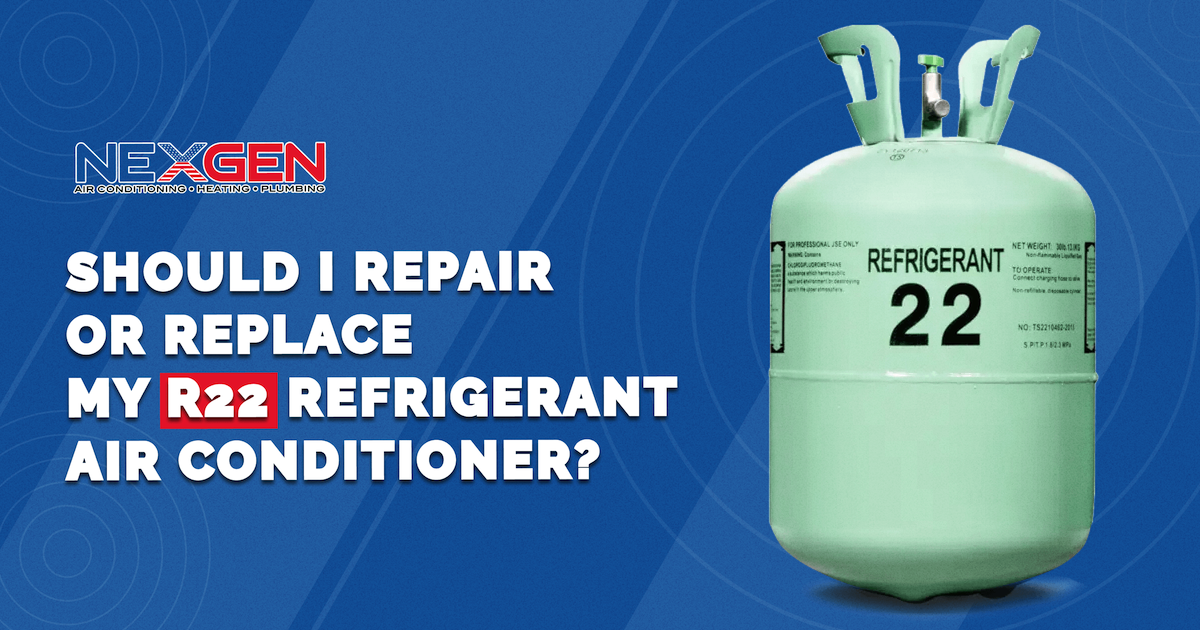 It has been illegal to produce or import R22 refrigerant in the U.S. since January 1, 2020. The Environmental Protection Agency’s (EPA) ban on this ozone-depleting substance began a phase-out of the product. Additionally, the manufacture of R22 AC or heat pump systems was banned to make way for chlorine-free R410A refrigerant.
The ban affects:
- Consumers who require AC or heat pump repair that involves refrigerant.
- Equipment manufacturers needing redesign systems to run with the new refrigerant.
The new R410A refrigerant is non-ozone depleting, environmentally friendly, and non-flammable. It also doesn’t contain butane, isopentane, isobutane, or other hydrocarbons.
Can an R22 Air Conditioner Still Be Repaired?
For now, you can still use your R22 air conditioner. However, fixing it can be problematic and expensive. Servicing it may require using R22 refrigerant stockpiles or reclaimed refrigerant. Like any AC system, old or new, these crucial pieces of HVAC equipment use refrigerant to absorb or release heat as it flows through a series of coils. Refrigerant transforms between liquid and gas states and undergoes pressure changes to exert a change in air temperature.
Repairing an old air conditioner can be expensive because R22 supplies are dwindling. You may find refrigerant for equipment made before 2010, but it’s only going to get even more expensive as time goes on. A leak can and should be repaired rather than simply topping off the system. But if you need a substantial amount of R22, it may cost more to repair the system than put money down on a new AC.
About Retrofitting an Existing System
Another alternative to replacement is retrofitting your current R22 air conditioner to work with the new refrigerant. Also known as a “drop-in” replacement, this requires significant modifications to equipment. Otherwise, it won’t run because R410A refrigerant requires different pressure levels than R22. If doing a retrofit, check the warranty to see if it’ll cover damages in case of a problem. There’s also the risk of voiding the system warranty and safety certification, which is another reason to consider a replacement.
Is It Time to Replace My R22 Refrigerant AC?
Squeezing another year or two out of your old system may ultimately cost more than replacing it sooner. The situation can get quite urgent if your old AC suddenly quits. Shopping around for a new heating and cooling system gives you time to plan and install it on your schedule. Meanwhile, you can evaluate product reviews, costs, and energy efficiency as well as the latest features.
Your AC dealer can also help you evaluate the best options for your home. Many offer financing options to help afford your new system. You can benefit from greater reliability and lower electric bills along with low monthly payments. Purchasing a new heating and cooling system does not have to be a financial strain.
Reasons to replace your R22 AC now include:
- Your air conditioner is 15 to 20 years old.
- A compressor or other major component has failed.
- The system isn’t providing adequate cooling.
- Refrigerant or water is leaking.
- Energy bills continue to increase.
- Moldy, burning, or sulfur odors.
- Grinding, shrieking, and other mechanical noises.
- Limited airflow.
- The system frequently needs repairs.
Nexgen’s Professionals Help Find the Right AC for Your Home
If your AC still uses R22 refrigerant, Nexgen can evaluate your home, determine the right sized air conditioner, and properly install and service it. Our certified technicians specialize in installation, repair, and maintenance of leading-brand equipment. We serve all of Southern California and provide indoor air quality, plumbing, and drain cleaning services as well. Under our X Protects plan, you’ll receive long-term warranties, multiple financing options, and services delivered to the highest standards. To learn more, call 833-729-9735.